Physics Analysis: di-Higgs
Why
The Standard Model
The Standard Model is our current reigning theory for describing the tiniest building blocks of the universe. And yet… somehow the Standard Model seems to leave us with more questions than answers… such as: What is the nature of dark matter? Could the structure encoded in the particles and their interactions hold a clue to a deeper theory? How do neutrinos get their mass? and How could gravity fit into this quantum story?
Due to the centrality of the Higgs boson in the Standard Model, understanding its properties and interactions is key to answering these questions.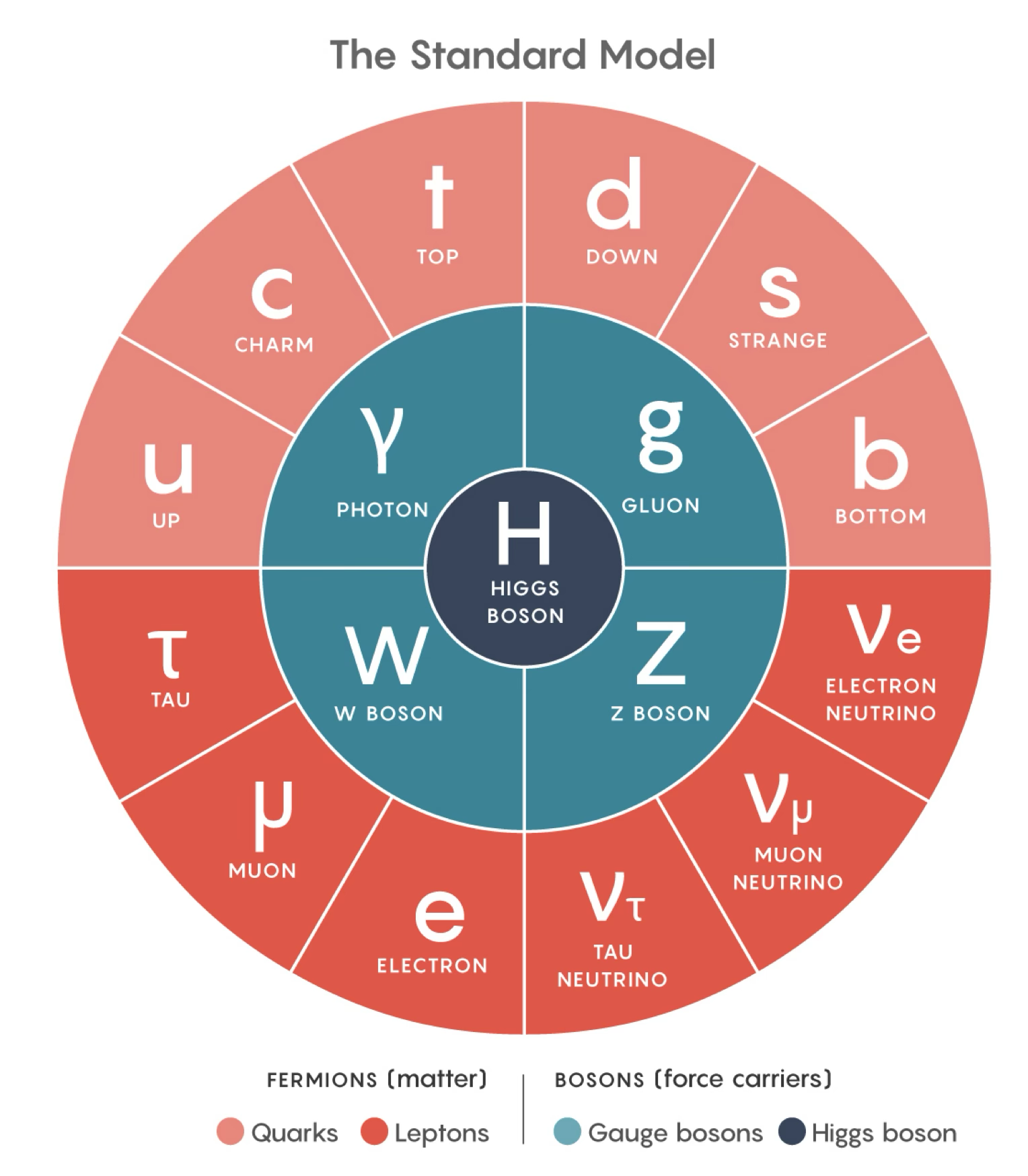
Source: Quanta magazine
The Higgs Potential
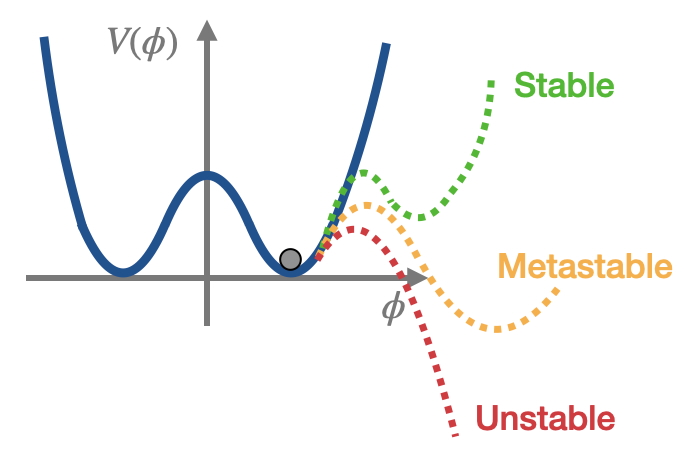
The particles that mediate the weak force get their mass from interactions with the Higgs boson, or more specifically its field1. This field has a potential energy, known as the Higgs potential (figure below). While V(φ) is symmetric about φ=0, its large value at φ=0 is an unstable equilibrium. Through electroweak symmetry breaking (EWSB) our universe "rolls down" this potential hill to select a new local extremum in which the weak bosons acquire mass. This theory necessitates the existence of a new massive particle, the Higgs boson, experimentally discovered in 2012 at the LHC.While this formula for the Higgs potential offers a consistent description for the matter content of the universe, it is merely an ansatz which has yet to be experimentally verified. Due to the centrality of the Higgs in particle physics and implications of this potential for the future stability of the universe, understanding the nature of EWSB is key to understanding nature, and one of the most pressing questions in particle physics.
1Imagine this field as an ocean. Excitations in a sea are waves, and excitations of the Higgs field are Higgs bosons.
What
Di-Higgs Production (HH)
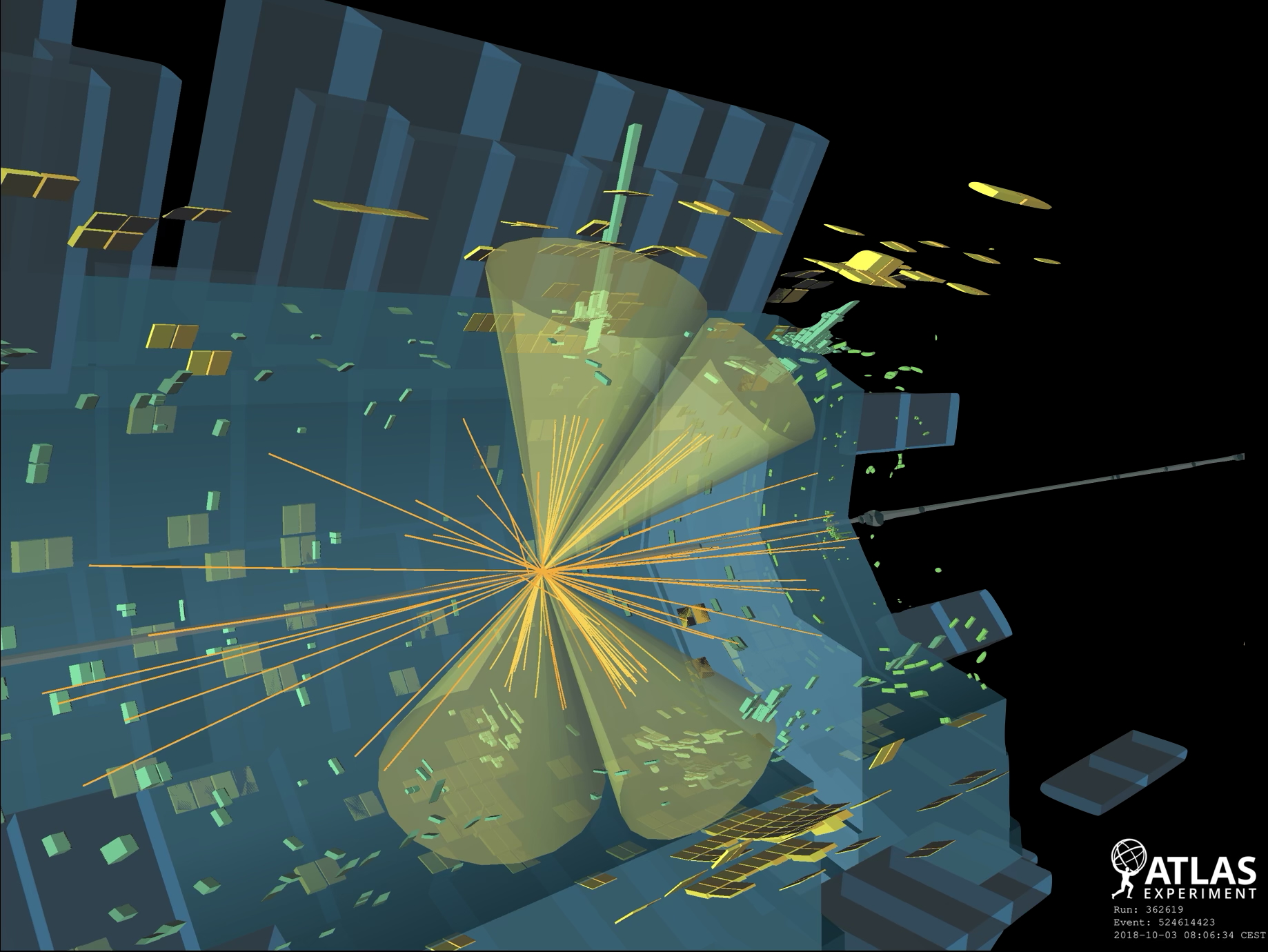
A first measurement of this potential could be obtained by the simultaneous production of two Higgs bosons (``di-Higgs’' or HH), an exceptionally rare process. Of the 40 million proton-proton collisions that happen each second at the LHC, we simultaneously produce two Higgs bosons only once per hour. Different shapes for the potential would give different HH production rates and kinematics, providing a clear signal if this potential deviates from the current expection.
Key result: $HH \rightarrow 4b$ non-resonant analysis
ATLAS Collaboration. "Search for non-resonant pair production of Higgs bosons in the 4b final state using 126 fb⁻¹ of pp collision data at √s = 13 TeV with the ATLAS detector." Phys. Rev. D 108 (2023) 052003, 10.1103/PhysRevD.108.052003
My Contributions:
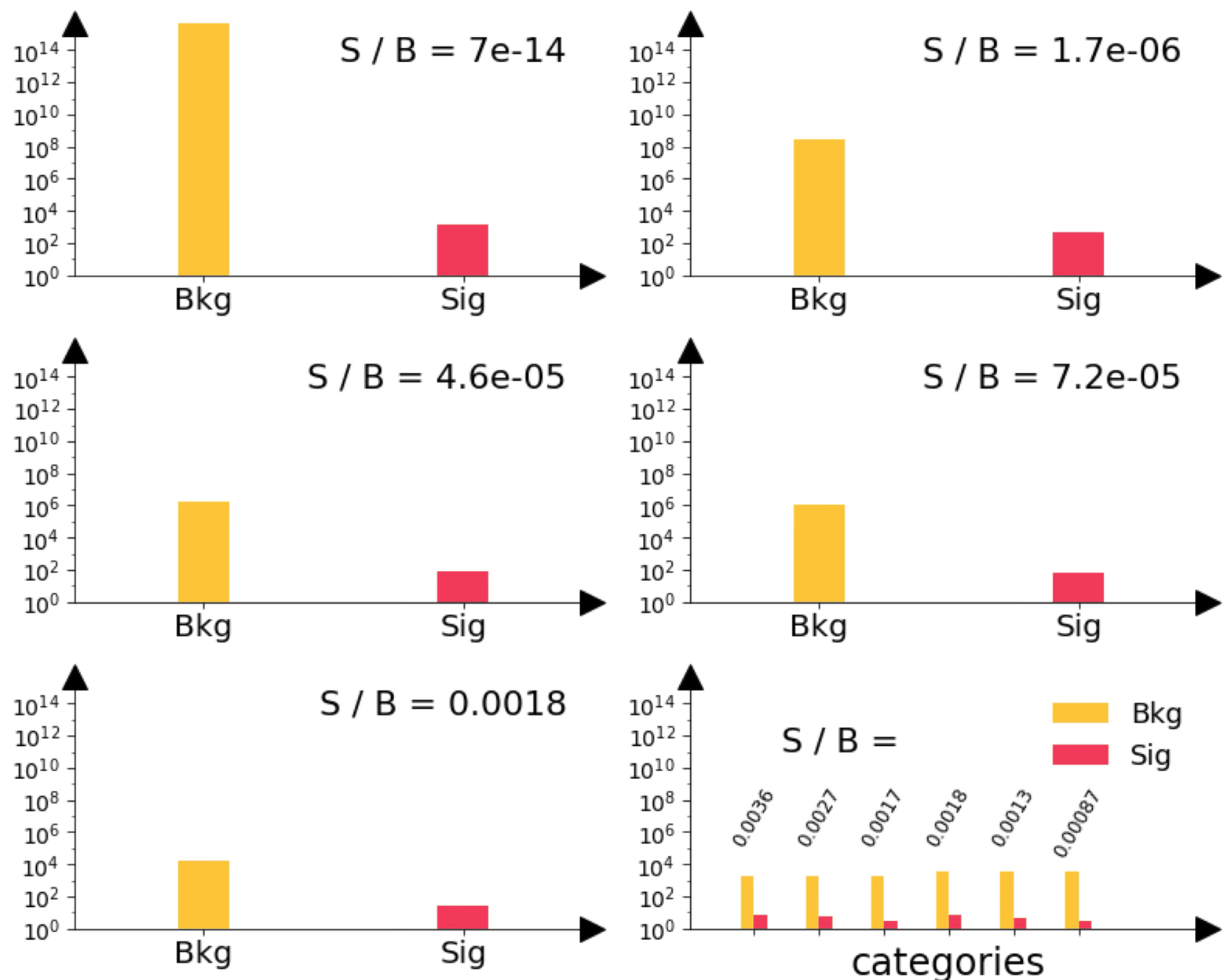
- Optimized analysis selection decreasing the combinatorial background by 70%. These optimizations and better b-taggers improved the analysis sensitivity by 30% compared to what was expected from a larger dataset.
- Designed new validation regions to provide state-of-the-art understanding of analysis' data-driven modeling uncertainties.
- Internal note editor: coordinated / summarized the work of O(50) people for analysis review.
How did we do?

What's next
The central challenge to this analysis is estimating the all hadronic background, which is challenging to simulate from first principles. In the above paper, we used a NN to reweight between two distributions. The details of this method are in the last chapter of my PhD thesis .
Ongoing Work
SH → 4b (analysis unblinded and finalizing approval)
- First ATLAS analysis to use the novel normalizing flows background estimate I developed in my PhD.