Methods Development
Finetuning Foundation Models for Joint Analysis Optimization
M. Vigl, NH, L. Heinrich. Finetuning Foundation Models for Joint Analysis Optimization. MLST 5, 10.1088/2632-2153/ad55a3.
Summary: Combination of neural networks for an end-to-end optimized analysis (jointly optimizing Higgs jet tagger and downstream event classifier). Proof-of-concept study for X → HH → 4b suggests a 2x improvement in background rejection.
Contribution: I found the dataset and reprocessed it with extra variables needed for combined training. Mentored M. Vigl on jet tagging and analysis.
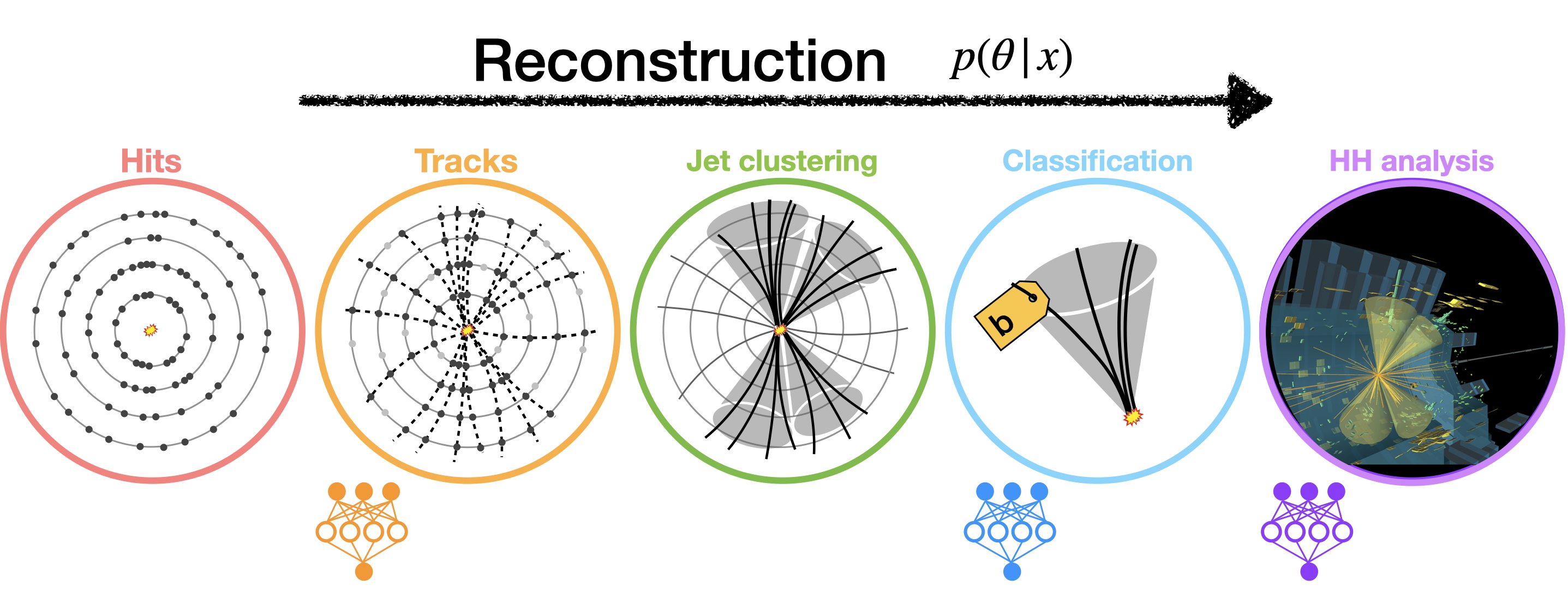
Hierarchical reconstruction pipeline: from detector hits through tracks, jet clustering, classification, to final HH analysis.
End-to-End Optimization
Traditional analysis pipelines optimize each step independently:
- Step 1: Train jet tagger to identify Higgs bosons
- Step 2: Train event classifier using fixed jet tagger outputs
Our approach jointly optimizes both networks together, allowing the jet tagger to learn features that are specifically useful for the final event classification task. This end-to-end training leads to significant performance improvements.
Foundation Model Finetuning
We leverage pre-trained foundation models and finetune them for the specific HH → 4b analysis, demonstrating how transfer learning can be effectively applied to particle physics analyses.
Hierarchical Clustering for Calorimeter Reconstruction
T. Jenegger, NH, R. Gernhäuser, L. Fabbietti, L. Heinrich. Machine learning for the cluster reconstruction in the CALIFA calorimeter at R3B, NIM-A, Vol 1082 (2026) 171048, 10.1016/j.nima.2025.171048.
In my role with the ORIGINS Data Science Lab (ODSL), I help scientists apply machine learning to their physics problems. This work is a recent example solving clustering for the NuStar detector at FAIR (Facility for Antiproton and Ion Research), a nucelar physics experiment.
Challenge
How can we accurately group together energy depositions that came from a single photon?Method Overview
This two-stage approach combines classical clustering algorithms with neural networks:
- Stage 1: Agglomerative clustering groups nearby calorimeter hits based on spatial proximity
- Stage 2: Edge detection neural network refines cluster boundaries and separates overlapping energy depositions
This new algorithm crucially benefits from the hit time information previously not exploited for photon clustering.
Result
We improved the cluster reconstruction efficiency of more than 30%, a key step forward for data analysis for these types of nuclear physics experiments.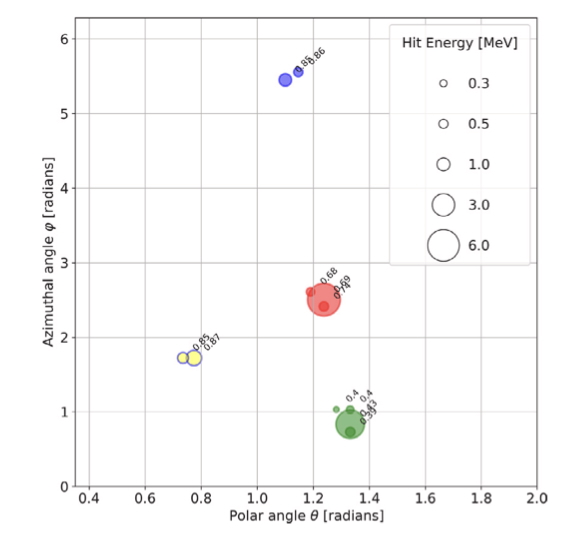
Cluster reconstruction in the CALIFA calorimeter. Each marker represents a detected hit, with the edge color indicating the true cluster assignment, and the fill color is assignment from the baseline algorithm. The baseline mistakenly splits the photon at (θ,ɸ) ≈ (0.6 rad, 2.7 rad) into a separate cluster (blue and yellow clusters), while the Agglo+Edge method correctly assigns all hits to the proper clusters for this event.
Other Methods Work
Foundation model for jet tagging
We're increase the size and input flexibility beyond ever before for our b-jet tagging models. See the Particle Identification page for more details.
Normalizing Flows for Background Estimation
Developed novel normalizing flow methods for high-dimensional background interpolation in blinded signal regions. See the Physics Analysis page for more details.